

What is SCOPT?
The Supply Chain OPTimisation (SCOPT) is a tool for the manufacturing logistics and supply chain optimisation problems developed by Cyprus University of Technology (CUT). The component is used to provide global (i.e. between the factories and suppliers) and local (within the factory) supply chain optimisations.
Why use the SCOPT tool?
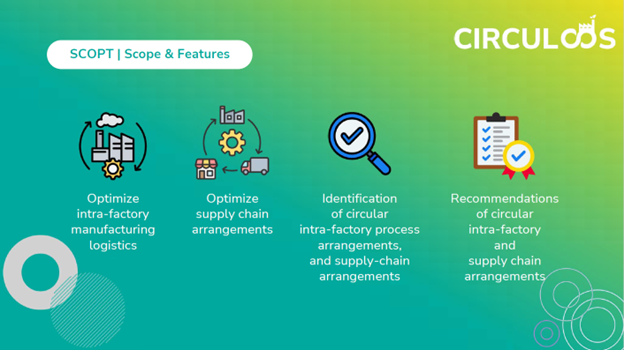
The SCOPT tool leverages a model-based approach to:
- Yield optimal (or optionally sub-optimal) results for intra-factory manufacturing logistics as well as for supply chain arrangements,
- Provide global (i.e. between the factories and suppliers) and local (within the factory) supply chain optimizations,
- Analyze the intra-factory manufacturing logistics and resources availability,
- Determine alternative supply chain arrangements,
- Provide optimisation results of the current processes.
How SCOPT works?
The SCOPT tool operates as follows: The abstraction model, called SPECTER’s task specification, of the intra-factory logistics or the supply chain arrangement needs to be constructed in a language specifically developed for the needs of this SPECTER task planner. Utilizing the abstraction model, SCOPT provides feasible and alternative solutions for the intra-factory logistics and supply chain optimization problems.
How to use SCOPT?
The SCOPT component is provided as a Software-as-a-Service. To provide the required input data for the SCOPT tool to construct the abstraction model of the factory or the supply chain, a data collection template is developed to describe a wide range of processes and factory setups, as well as interconnections between the actors in the supply chain. Retrieving data from template, the abstraction model of the intra-factory logistics and supply chain arrangement is constructed.
A video detailing the use of the template for data collection is provided along with 3 examples on how to fill the template could be found here
The SCOPT tool follows the standard EU regulations utilizing authentication for the communication between the tools to secure the confidentiality, protection and data sharing of the experiments. So, all data provided by the users is confidential.
SCOPT communication with other CIRCULOOS tools
The SCOPT will interact with Supply Chain Digital Twin (SCDT) and GREen TArgets (GRETA) tools in order to retrieve data for the factory and supply chain models as well as the Life Cycle Assessment (LCA) indicators of product, processes, production lines or factories through the CIRCULOOS Data Platform. From the SCDT tool, SCOPT receives the data required to construct the abstraction model of the factory or the supply chain through the Data Platform. From the GRETA tool, SCOPT retrieves the relevant LCA indicators through the Data Platform. SCOPT publishes the results to the Data Platform. The results can be visualized in the SCDT model. It is recommended to utilize the SCDT tool for visualization.
Scenario: Intra-factory logistics and Supply chain arrangements optimization problem
A case study to demonstrate the capabilities and features of SCOPT is the following. In the Figure 1 is illustrated an example of intra-factory logistics and supply chain arrangement.
Consider Factory X that utilizes 2 different raw materials that pass through 3 different operations in order to produce 2 different final products and some scrap. Factory X interacts with Factories A, B and D. Raw materials are received from Factory A and Factory B, final products are provided to Factory D and its scrap is provided to Factory B. Factory B recycles the scrap from Factory X and produces raw materials for Factory X and Factory A. The raw materials are considered as input resources, the final products are considered as output products and the scrap is the waste. Moreover, the suppliers and the consumers need to be specified.
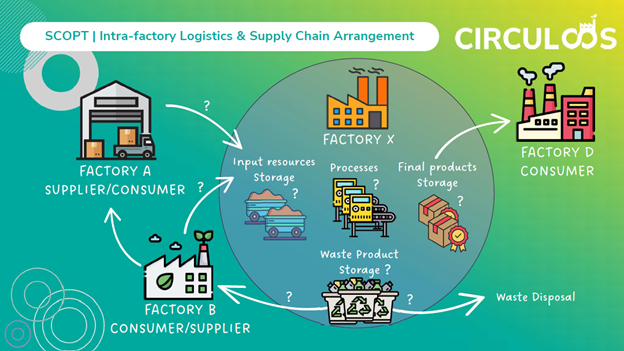
In this example the suppliers of Factory X are: i) the Factories A and B that provide the raw materials; and the consumers of Factory X are: i) the Factory D that receives the final products and ii) the Factory B that receives the scrap.
Additionally, the relevant cost indicators should be provided for each process (i.e. CO2 emission or energy consumption per process).
The problem that we aim to solve is the following: “The Factory X faces the problem of deciding from where to receive its input resources, what types of processes to implement, what to do with the waste products and what is the size of the buffers that they are going to be used for its input, its outputs and its storage.” Also, there are several options for the supply chain.
In this case, SCOPT can provide valid arrangement of the supply chain, valid arrangement of intra-factory operations and also look into providing optimal solutions for such arrangements.