
How can regions help transform industrial waste into new local value chains? This question guided the CIRCULOOS session at the European Week of Regions and Cities, where the project explored how circular manufacturing can become a driver of regional innovation and competitiveness.
The session presented the CIRCULOOS approach to helping SMEs build more circular supply chains through real-world pilots, digital tools and new collaboration models. Three cases illustrated this in practice: recycled plastics for automotive components in Spain, leather waste reused for fashion and accessories in Hungary, and reclaimed wood for sustainable construction in the Netherlands.
The discussion went beyond technology to examine the broader conditions needed for these value chains to emerge and scale: access to reliable material data, collaboration among actors, skills, funding, supportive regulation, and sufficient market demand.
This regional perspective was particularly relevant for an audience made up largely of local and regional authorities, Managing Authorities of EU-funded programmes, regional development agencies, national administrations, EU institutions, civil society organisations, research actors and beneficiaries of European projects. The conversation therefore focused not only on what companies can do individually, but also on the role of regional ecosystems in connecting manufacturers, recyclers, technology providers and public authorities.
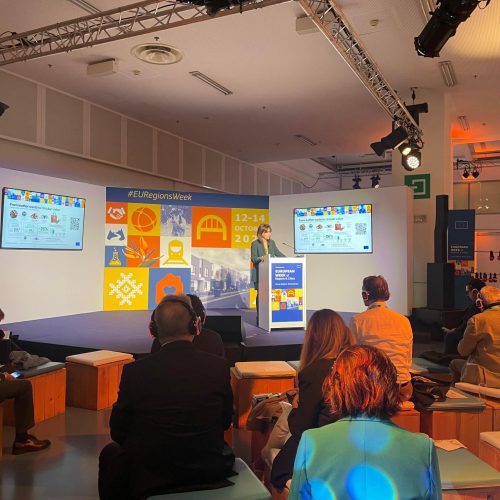
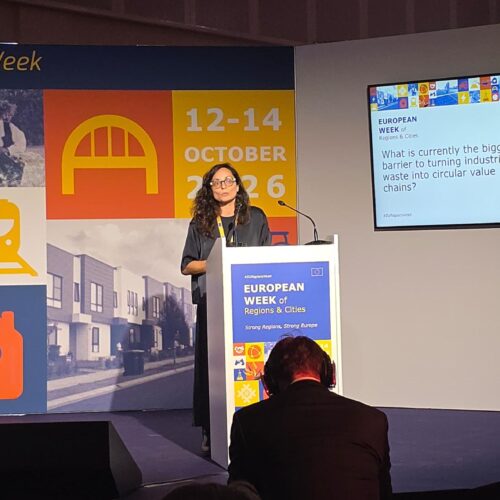
The session was led by Marjorie Grassler, EU Project Manager at Mobile World Capital Barcelona, and Elia Mercedes Ruiz Pachon, researcher at SUPSI – University of Applied Sciences and Arts of Southern Switzerland. Together, they explored what can be learned from the CIRCULOOS pilots and what regions need in place to support the replication of circular value chains.
At the end of the session, speakers and participants exchanged perspectives on the project and on the conditions needed to replicate circular value chains in different regional contexts. The discussion reinforced a central message: circular manufacturing is not only a technological challenge, but also an ecosystem challenge requiring coordination, enabling conditions and collaboration across sectors.